Animal RFID Read Range: What Affects Tag and Reader Performance?
Learn what affects animal RFID read range, including protocol, antenna orientation, tag design, reader power, environment and sample testing.
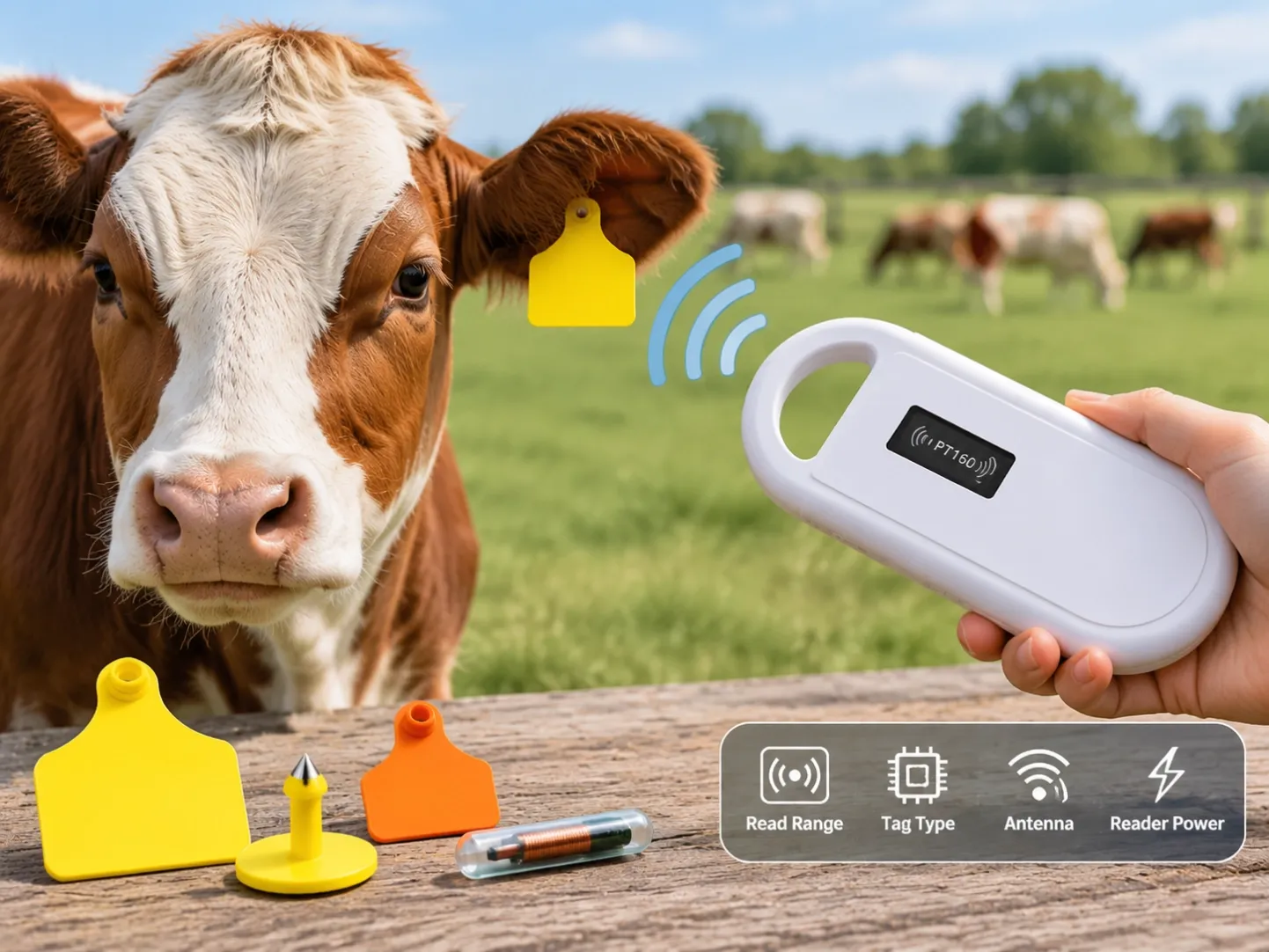
Animal RFID read range is often discussed as if it were a fixed number. In practice, the usable distance depends on the tag, reader, antenna, protocol, orientation and installation environment working together.
Before a bulk order, buyers should test the intended tag and reader under the same conditions in which the system will be used.
Read Range Depends on the Whole System
A tag specification alone cannot guarantee the final read distance. The same tag may perform differently with two readers, and the same reader may produce different results when the tag position or surrounding environment changes.
For animal identification projects, define the required workflow first: close-range handheld scanning, a fixed passage, a raceway, a weighing station or another controlled reading point.
1. Frequency and Protocol
Livestock identification systems commonly use low-frequency RFID. International animal identification projects often refer to 134.2 kHz FDX-B or HDX technology and ISO 11784/11785 compatibility. Some markets also use other low-frequency systems.
Frequency alone is not enough. Confirm the exact protocol supported by both the tag and reader. A reader that supports one protocol may not identify every tag that operates in a similar frequency range.
Review our animal RFID identification products when comparing tag formats and reader requirements.
2. Reader Antenna and Power
The reader antenna creates the field that energizes a passive tag and receives its response. Antenna size, shape, tuning and reader power can affect the practical reading zone.
- Handheld readers are useful for individual animals and sample testing.
- Fixed readers may support a controlled reading area when the antenna and passage are installed correctly.
- Reader settings should match the tag protocol and intended data output.
For portable testing, see the PT160 handheld animal ID reader.
3. Tag Shape and Antenna Design
RFID ear tags, glass transponders, boluses and other tag formats use different internal antenna designs. Physical size, coil design, housing material and manufacturing consistency can influence performance.
A larger-looking tag does not automatically provide a longer read range. Compare complete samples rather than choosing by external dimensions alone.
4. Orientation and Position
RFID coupling changes when the tag is rotated or moved away from the reader's strongest field. A tag may read reliably in one orientation and less consistently at another angle.
Test the position that animals will actually present during scanning. For ear tags, include left and right ear placement, animal movement and the operator's normal reader position.
5. Metal, Electrical Noise and the Environment
Nearby metal structures, motors, cables, electronic equipment and electromagnetic noise can reduce system performance. Moisture, dirt, animal movement and reader-to-reader interference may also affect field results.
Testing in an office is useful for an initial check, but it should be followed by testing at the farm, raceway, gate or workstation where the equipment will operate.
6. Software and Data Output
A successful scan is only one part of the workflow. Confirm how the reader displays, stores and transfers the animal ID. Check Bluetooth, USB, serial connection or other required interfaces before purchasing.
Buyers should also confirm the ID format, leading zeros, software import method and whether duplicate scans need to be filtered.
How to Test Before a Bulk Order
- Confirm the required frequency and protocol.
- Obtain representative tag and reader samples.
- Test every tag type with the exact reader model.
- Repeat tests at different angles and distances.
- Test near the intended metal structures and electrical equipment.
- Verify data transfer to the software used by the project.
- Record the reliable operating zone rather than the single longest successful scan.
Animal RFID Buyer Checklist
- Animal species and application
- Tag format and dimensions
- Frequency and protocol
- Reader model and supported standards
- Expected operating distance and reading point
- Handheld or fixed installation
- Data interface and software format
- Sample quantity and field-test plan
- Bulk quantity and delivery country
Frequently Asked Questions
Can a supplier guarantee one read distance for every installation?
A practical distance should be verified with the selected tag, reader and installation environment. Field conditions can change the result.
Does a more powerful reader solve every range problem?
No. Protocol compatibility, antenna design, orientation, interference and installation also matter.
What information should I send for a quotation?
Send the animal species, required tag type, protocol, reader model, target workflow, sample quantity, bulk quantity and delivery destination. If specifications are incomplete, reference photos and the current reader label can help with review.
Request an RFID Compatibility Review
Contact IMINID with your tag and reader requirements. We can discuss sample testing, compatibility checks and bulk-order preparation before production.